Description
The standard domestic bulk tank. Heat, hot water, cooking and a dryer on one vessel, refilled a couple of times a year rather than monthly.
It comfortably carries central heating, hot water, a cooking range and a dryer on one property.
Filled to the 80% limit this vessel holds about 400 gallons of propane — roughly 37 million BTU, or about 1,696 lb of product. Against a steady 100,000 BTU/hr load that is roughly 15 days of continuous running before it needs refilling.
Against the 330 gallon it buys real headroom; against the 1,000 it saves footprint and pad. That trade-off is usually decided by the site, not the load.
Key specification
- Rated water capacity: 500 gallons
- Usable propane at 80% fill: approximately 400 gallons
- Filled product weight: approximately 1,696 lb
- Energy held when full: approximately 37 million BTU
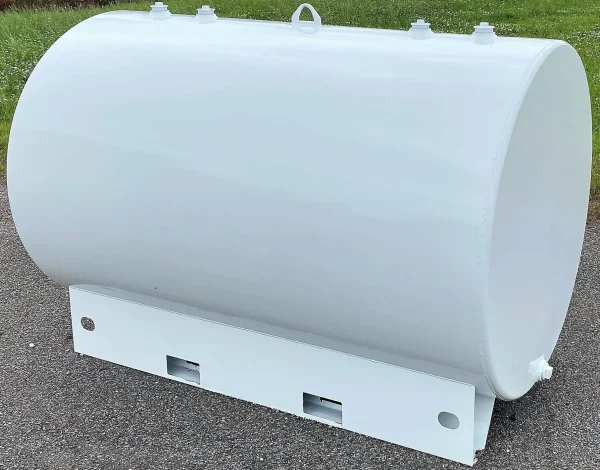
- Installation: Skid mounted
- Certification: ASME stamped
- Condition: Confirmed on your invoice
- Fuel: Propane / LPG
Siting and installation
The skid frame carries the vessel and its fittings as a single lift. That matters on sites where a permanent foundation is not wanted, or where the storage has to follow the work.
We supply and deliver; we do not install. A propane vessel must be set and commissioned by a licensed propane professional under NFPA 58 and your local code.
Condition and documentation
Every vessel is stamp-verified and pressure tested before dispatch, and the data plate photograph and test record travel with the invoice.
We check the relief valve, the service and fill connections and the float gauge on every unit. These are the parts that fail first and the parts that matter most.
Cost of ownership
Owning the tank rather than leasing it means you choose the supplier. That single change is usually worth more over five years than the difference in purchase price between capacities.
Before you order
Buy the documentation, not just the steel. A vessel without a legible stamp and a test record is worth a fraction of one with both, whatever the listing says.
Think about the delivery vehicle as well as the tank. A site a bulk truck cannot reach turns a cheap refill into an expensive one for the rest of the tank’s life.