Description
A genuinely useful middle size: enough capacity to carry heating and hot water through a cold snap without dominating the yard.
Typical service is a small house, a holiday let, or a well-insulated property with a light heating demand.
Filled to the 80% limit this vessel holds about 200 gallons of propane — roughly 18 million BTU, or about 848 lb of product. Against a steady 100,000 BTU/hr load that is roughly 8 days of continuous running before it needs refilling.
Against the 200 gallon it buys real headroom; against the 320 it saves footprint and pad. That trade-off is usually decided by the site, not the load.
Key specification
- Rated water capacity: 250 gallons
- Usable propane at 80% fill: approximately 200 gallons
- Mass of propane at full fill: approximately 848 lb
- Stored energy when full: approximately 18 million BTU
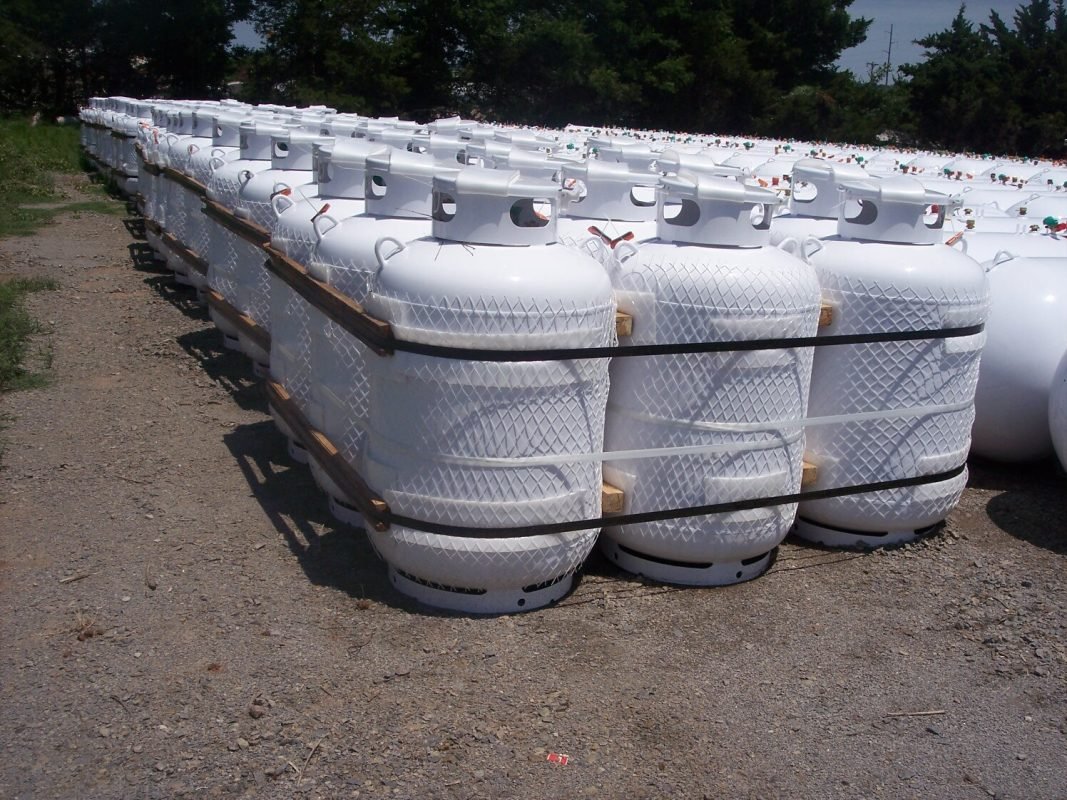
- Installation: Above ground
- Orientation: Vertical
- Certification: ASME stamped
- Condition: Confirmed on your invoice
- Fuel: Propane / LPG
Siting and installation
Above-ground siting is the straightforward option: no excavation, no anode bag, and every valve and the gauge are reachable without opening a dome. It sits on legs or saddles on a level pad and can be inspected in place for the whole of its service life.
Setting and commissioning must be done by a licensed propane professional in line with NFPA 58 and local code. Ask us if you need a name in your area.
Certification and paperwork
Condition is confirmed on the invoice. Whichever we ship, it is stamp-verified, pressure tested, and documented for the specific unit you receive.
Fittings are verified before the vessel leaves the yard: relief valve condition, gauge operation, and clean threads on every connection.
Cost of ownership
Owning the tank rather than leasing it means you choose the supplier. That single change is usually worth more over five years than the difference in purchase price between capacities.
Before you commit
Think about the delivery vehicle as well as the tank. A site a bulk truck cannot reach turns a cheap refill into an expensive one for the rest of the tank’s life.
Have the appliance ratings to hand when you call. Total BTU and the climate decide the capacity; everything else is siting.