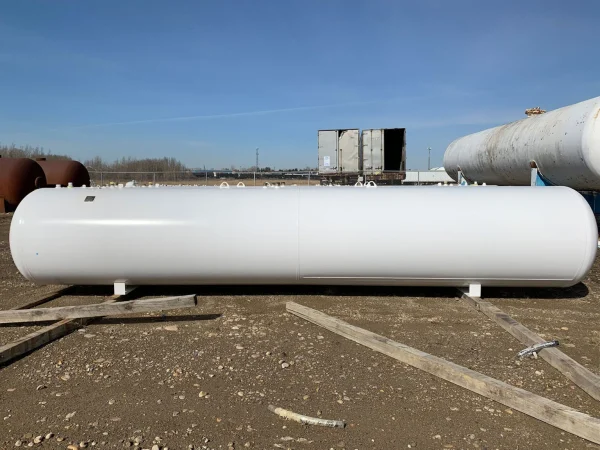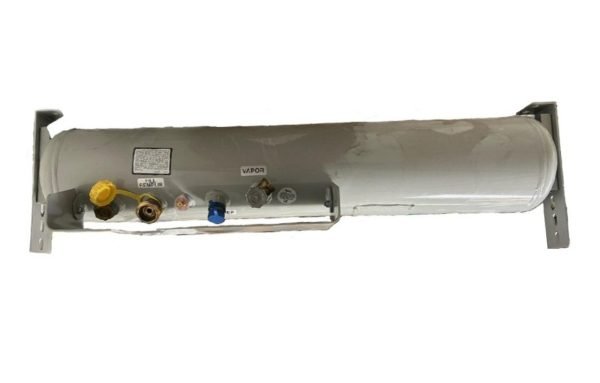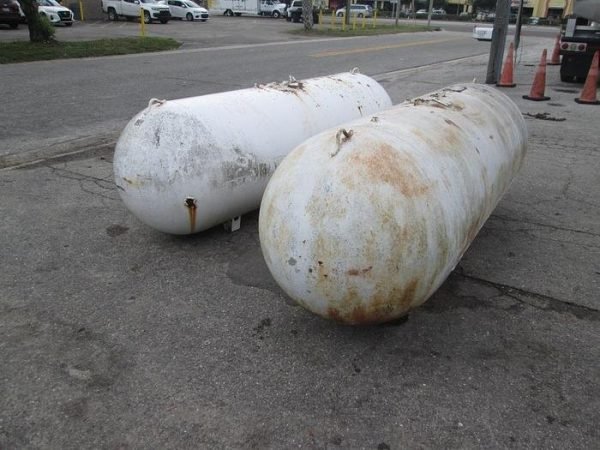
Description
Sized for properties and businesses whose load would empty a domestic tank inside a month of cold weather.
It supports several heavy appliances at once, or a seasonal process load that would flatten a domestic tank.
Filled to the 80% limit this vessel holds about 800 gallons of propane — roughly 73 million BTU, or about 3,392 lb of product. Against a steady 100,000 BTU/hr load that is roughly 30 days of continuous running before it needs refilling.
The next size down is 500 gallons and the next up is 1,150. Stepping up costs less than most people assume once freight is counted only once.
Technical details
- Rated water capacity: 1,000 gallons
- Working volume (80% fill): approximately 800 gallons
- Weight of propane when filled: approximately 3,392 lb
- Heat content at full fill: approximately 73 million BTU
- Installation: Above ground
- Certification: ASME stamped
- Condition: Confirmed on your invoice
- Fuel: Propane / LPG
Siting and installation
Above ground means the vessel can be repainted, re-valved and re-certified in place. Over a thirty-year life that accessibility is worth more than the visual advantage of burying it.
We supply and deliver; we do not install. A propane vessel must be set and commissioned by a licensed propane professional under NFPA 58 and your local code.
Condition and documentation
Condition is confirmed on the invoice. Whichever we ship, it is stamp-verified, pressure tested, and documented for the specific unit you receive.
We check the relief valve, the service and fill connections and the float gauge on every unit. These are the parts that fail first and the parts that matter most.
Refills and running costs
Capacity is cheap compared with delivery. The incremental cost of the next size up is usually recovered within a few heating seasons.
Before you commit
Size against the real load, not the optimistic one. A vessel one size too small costs more across ten years of refills than the larger one did on the day you bought it.
Ask what the regulator and first-stage arrangement will be. The tank is only half the specification, and the wrong regulator will starve appliances the vessel could easily supply.